


How long does a triathlon take? If you are preparing for your first race, this is probably one of the first questions you will ask. Many recreational athletes complete a sprint triathlon in approximately 1 hour 30 minutes to 2 hours, while 2 hours 45 minutes to 3 hours 45 minutes can be a useful starting point for an Olympic-distance triathlon. But finish times vary considerably. Your swimming pace, average cycling speed, running pace and the course itself all play a part. Here is how to estimate a realistic triathlon finish time, with example calculations and actual results from the Hamburg Triathlon 2026.
How long does a sprint triathlon take?
A sprint triathlon typically consists of a 750-metre swim, a 20-kilometre bike ride and a 5-kilometre run. For many athletes, it is their first introduction to triathlon racing.
How long you need to finish depends mainly on your experience and fitness level. While some competitive age-group athletes complete a sprint triathlon in under an hour, beginners often take considerably longer.
A finish time of approximately 1 hour 30 minutes to 2 hours can be a reasonable target range for many recreational athletes. However, this is a general guideline rather than a statistically calculated average across all races.

Example: Calculating your sprint triathlon finish time
Let's say you swim at an average pace of 2:20 minutes per 100 metres, cycle at 25 km/h and run the 5 kilometres at 6:00 minutes per kilometre.
Your race could look something like this:
| Discipline | Pace / Speed | Time |
|---|---|---|
| 750 m swimming | 2:20 min/100 m | 17:30 min |
| 20 km cycling | 25 km/h | 48:00 min |
| 5 km running | 6:00 min/km | 30:00 min |
| Transitions | T1 + T2 | 6:00 min |
| Total finish time | 1:41:30 |
With these numbers, you would finish your sprint triathlon in approximately 1 hour and 42 minutes. This is an example calculation, not an average taken from actual race results.
For your first race, it is also worth allowing some extra time. Swimming in open water can feel very different from training in a pool, and running after cycling can be harder than running on fresh legs.
How long does an Olympic-distance triathlon take?
The Olympic distance, also known as the standard distance, is twice as long as a sprint triathlon. It consists of a 1,500-metre swim, a 40-kilometre bike ride and a 10-kilometre run.
The longer distance places greater demands on endurance and pacing. If you push too hard during the early stages of the bike leg, you may pay for it during the final 10 kilometres of running.
For many recreational triathletes, a finish time of around 2 hours 45 minutes to 3 hours 45 minutes can be a useful reference. Depending on the course, conditions and individual fitness, actual times can be significantly faster or slower.
Example: Calculating an Olympic-distance triathlon time
Let's assume you maintain the same swimming pace as in the sprint example, increase your average cycling speed to 27 km/h and run the 10 kilometres at 6:00 minutes per kilometre.
| Discipline | Pace / Speed | Time |
|---|---|---|
| 1,500 m swimming | 2:20 min/100 m | 35:00 min |
| 40 km cycling | 27 km/h | 1:28:53 |
| 10 km running | 6:00 min/km | 1:00:00 |
| Transitions | T1 + T2 | 8:00 min |
| Total finish time | 3:11:53 |
With these performances, you would complete the Olympic distance in approximately 3 hours and 12 minutes.
Calculations like this can help you set an initial race target. Just remember that your performance in individual training sessions will not always translate directly into a triathlon. Running 10 kilometres after 40 kilometres on the bike can feel very different from a standalone run.
How fast are triathletes in real races? Hamburg 2026 results
To put these example times into perspective, it helps to look at actual race results. On July 11 and 12, 2026, numerous age-group athletes competed over the sprint and Olympic distances at the World Triathlon Hamburg.
The fastest finishers in each age-group race demonstrate the level of performance possible among competitive amateur triathletes:
| Distance | Fastest Man | Fastest Woman |
|---|---|---|
| Sprint distance | 57:47 | 1:06:35 |
| Olympic distance | 1:59:37 | 2:10:16 |
These times come from the age-group races at the Hamburg Triathlon 2026. They represent the fastest finishers, not the average finishing times of all participants.
You can find the published results on tri2b for both the sprint distance and the Olympic distance.
These performances are impressive, but they are not particularly useful as direct benchmarks for beginners. A more important question is what you can realistically achieve based on your own training.
Why is there no universal average triathlon finish time?
Comparing triathlon finish times is not quite as simple as comparing results from a flat 5-kilometre road race. Conditions can vary significantly between events, even when the official race distance is the same.
Some of the biggest factors include:
- Course profile: A flat cycling course is usually faster than a hilly route with several demanding climbs.
- Weather: Wind, heat and rain can affect performance. During the swim, waves and currents may also influence your pace.
- Actual course distance: Not every event uses exactly the same distances. Some smaller races may have slightly different course lengths.
- Participants: A race with many experienced club athletes may produce different average finish times than an event attracting mostly beginners.
- Transition areas: Long distances between the swim exit, bike racks and running course can add extra minutes to your overall time.
When comparing average triathlon times from different events, it is therefore important to consider the conditions rather than looking only at the finishing time.
For a broader overview of race formats, take a look at the existing sailfish guide to triathlon distances.
How to calculate your own triathlon finish time
You do not have to wait until your first race to get a reasonable idea of your potential finish time. A few numbers from your training sessions can already give you a useful estimate.
1. Calculate your swimming time
Swim 750 or 1,500 metres at a consistent pace during training and record your time. Alternatively, use your average pace per 100 metres.
For example, at 2:00 minutes per 100 metres, swimming 750 metres takes 15 minutes. At the same pace, 1,500 metres would take 30 minutes.
Keep in mind that navigation, crowded starts, waves and water temperature can all affect your actual open water swimming time.
2. Estimate your cycling time
For the bike leg, your average speed on a route with a similar elevation profile is the most useful starting point.
If you cycle 20 kilometres at 25 km/h, you will need 48 minutes. Maintaining that same speed over 40 kilometres would take 1 hour and 36 minutes.
Try to use the average from several training rides rather than your fastest session with a strong tailwind.
3. Be realistic about your running pace
Your personal best over 5 or 10 kilometres is not necessarily the pace you will be able to maintain at the end of a triathlon.
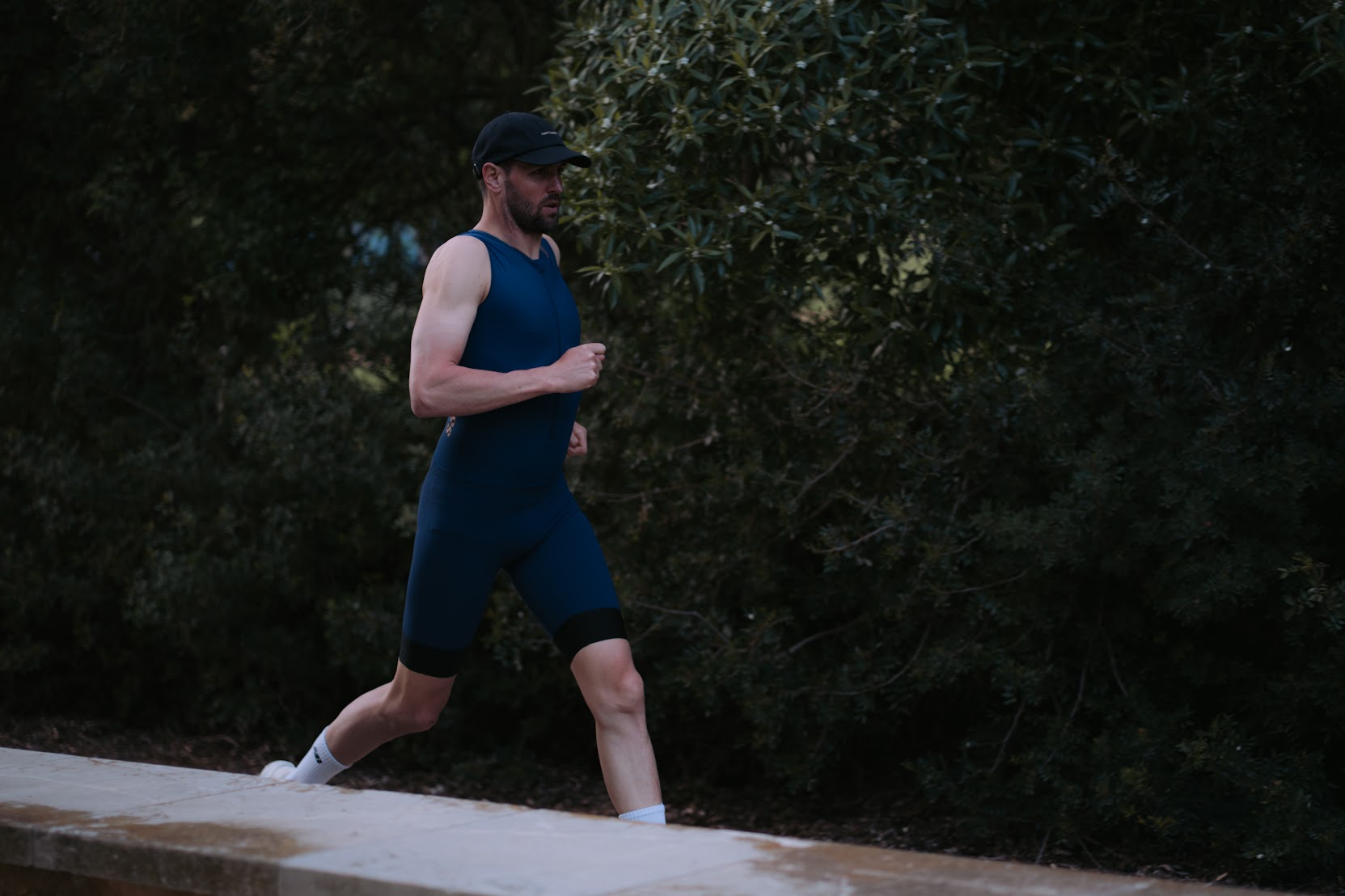
The first few kilometres after cycling can feel particularly uncomfortable. This is why it is worth including occasional brick sessions, where you start running immediately after finishing a bike workout.
If you normally run 10 kilometres at 5:30 minutes per kilometre, it may make sense to use a slightly more conservative pace when planning your triathlon. How much slower you might be depends on your training and race strategy.
4. Remember your transition times
In triathlon, the clock keeps running during both transitions. The time you spend taking off your wetsuit, reaching your bike or changing into your running shoes can easily add several minutes.
For your first race, allow a little extra time. As you become more familiar with the process, your transitions will usually become faster.
How can you improve your triathlon finish time?
When athletes want to improve their overall finish time, they often focus on cycling faster or increasing their running pace. But it is also worth taking a closer look at the swim.
Especially for beginners, this is often where there is considerable room for improvement. Better body position and a more efficient stroke can help you turn the effort you put into swimming into more forward movement.
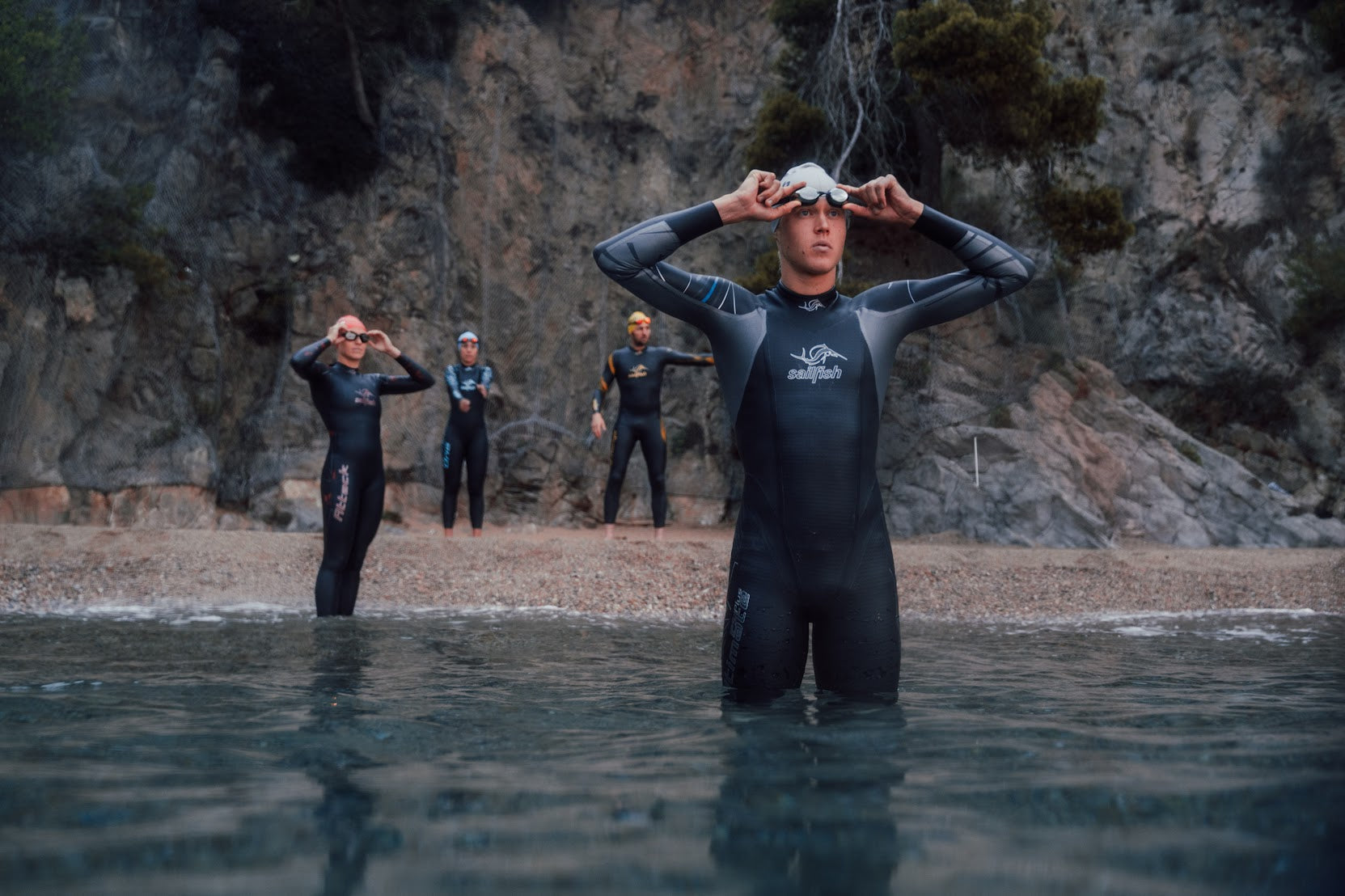
In open water, choosing the right wetsuit can also make a difference. A well-fitting wetsuit provides additional buoyancy and can help support a more efficient position in the water.
The sailfish Ignite 3 was designed specifically for athletes getting started in triathlon. It combines comfortable freedom of movement with buoyancy, and its construction makes it easier to put on and remove.
A reliable pair of swimming goggles is another important part of your equipment. The sailfish Rush offers a wide field of vision and is suitable for training in the pool as well as in open water.
Just as important as your equipment is pacing the race correctly. If you start the swim under control and avoid pushing too hard on the bike, you will be in a better position to maintain your pace during the final run.
What is a realistic finish time for your first triathlon?
For your first triathlon, try not to focus too much on other people's finishing times. Different fitness levels, racecourses and weather conditions often make direct comparisons difficult.
Instead, set yourself a realistic goal based on your current training. Maybe you want to complete your first sprint triathlon in under 1 hour 45 minutes, or finish an Olympic-distance event in less than three hours.
What matters is choosing a target that matches your ability. Completing your first race at a controlled pace gives you a good foundation to build on for your next one.
Frequently asked questions about triathlon finish times
What is a good sprint triathlon time?
That depends on your experience and the course. For many beginners, a finish time of approximately 1 hour 30 minutes to 2 hours can be a useful reference. Well-trained triathletes can complete the distance considerably faster.
What is the average Olympic triathlon time?
There is no single statistically valid average for all Olympic-distance triathlons. For many recreational athletes, approximately 2 hours 45 minutes to 3 hours 45 minutes can be a useful guideline. Actual finishing times vary significantly depending on the course and the athlete.
How long does it take to swim 750 metres in a triathlon?
At a pace of 2:00 minutes per 100 metres, swimming 750 metres takes exactly 15 minutes. At 2:30 minutes per 100 metres, the swim takes 18 minutes and 45 seconds.
How long does it take to swim 1,500 metres in a triathlon?
At 2:00 minutes per 100 metres, the swim takes 30 minutes. At a pace of 2:30 minutes per 100 metres, it takes 37 minutes and 30 seconds. Actual open water swim times may vary.
Do transition times count towards your overall triathlon time?
Yes. The clock continues running throughout the race. Taking off your wetsuit, switching to your bike and later changing into running shoes all count towards your total finish time.
Which is faster: a sprint or an Olympic-distance triathlon?
A sprint triathlon is shorter and therefore usually takes less time to complete. It consists of a 750-metre swim, 20 kilometres of cycling and a 5-kilometre run. The standard Olympic distance is twice as long in each discipline.
How can I predict my triathlon finish time?
Add your estimated swimming, cycling and running times, including both transitions. Use realistic training results and allow for possible differences caused by race conditions.
How fast was your first triathlon?
Most triathletes remember their first finish time. Whether you crossed the line in just over an hour or needed considerably longer, that first race is often a special experience.
What distance did you choose for your first triathlon, and how long did it take you to finish?
Share your time and experience in the comments!


Leave a comment