


You train regularly, work on your endurance and try to improve your freestyle technique. But sometimes your stroke still feels restricted, your body rotation is difficult or your legs sit lower in the water than you would like. If that sounds familiar, it might be worth looking beyond your training in the pool.
Alongside strength, endurance and technique, mobility plays an important role in swimming. Your shoulders, thoracic spine, hips and ankles all need sufficient freedom of movement to perform your swimming strokes with control and without unnecessary restrictions.
The winter months are a great opportunity to work on exactly that. With race season still some time away, you can focus on building the physical foundations for your swimming. You do not need a gym or hours of additional training. A few minutes and the right exercises can be a good starting point.
In this guide, you will discover which areas matter most for swimming, five mobility exercises worth adding to your routine and how to make mobility training a regular part of your week.
Why Mobility Matters in Swimming
Swimming is a technically demanding sport. Unlike running or cycling, you move through an environment where even small changes in body position can affect water resistance.
For an efficient freestyle stroke, several movements need to work together. Your arms reach forward, your upper body rotates around its longitudinal axis, your hips support the movement and your feet help generate propulsion and stability through a controlled kick.
To perform these movements effectively, your body needs sufficient freedom of movement. If rotation in your thoracic spine is restricted, for example, it may become harder to rotate your upper body smoothly. Limited ankle mobility can also cause your feet to create additional resistance during the freestyle kick.
However, greater flexibility does not automatically make you a faster swimmer. What matters is being able to control the range of motion required for your swimming technique. This is where mobility becomes just as important as flexibility.
Flexibility vs. Mobility: What Is the Difference?
The two terms are often used interchangeably, but they are not exactly the same.
Flexibility generally refers to the range of motion available around your joints and surrounding tissues. Mobility also involves your ability to actively control movement through that range.
Both matter for swimmers. After all, being able to raise your arm far above your head is of limited benefit if you cannot control that position during your freestyle stroke.
Effective mobility training therefore combines flexibility exercises with controlled, active movements.
Four Key Areas for Swimmers
Swimming involves your entire body, but some areas deserve particular attention when it comes to mobility and efficient technique.
1. Shoulders: Freedom of Movement for Your Stroke
Your shoulders are among the most heavily used areas of your body during freestyle swimming. With every stroke, your arm reaches forward, enters the water, establishes pressure and moves through the pull phase before recovering above the surface.
This movement requires sufficient shoulder mobility and good control of the shoulder blades.
When shoulder movement is restricted, it can become more difficult to achieve a comfortable and effective arm position during entry and the pull phase. Other parts of your body may also compensate for the missing range of motion.
The goal is not to stretch your shoulders as far as possible. It is to move through the range required for your stroke with control and without pain.
2. Thoracic Spine: The Foundation of Controlled Rotation
Your upper body does not remain completely still during freestyle. It rotates slightly around the body's longitudinal axis with each stroke, helping coordinate your arm movement and breathing.
An important part of this rotation comes from your thoracic spine, the middle and upper section of your back.
If mobility in this area is limited, rotating your upper body smoothly may become more difficult. You might notice this especially when breathing, as you may need to lift or turn your head more than necessary.
Thoracic rotation exercises are therefore a useful addition to swimming training.
3. Ankles: A Small Movement With a Big Role in Your Kick
Ankle mobility is often overlooked in swimming.
During the freestyle kick, your feet should be able to move relatively freely in line with your legs. Sufficient plantar flexion, the ability to point your toes away from your body, helps position your feet more effectively in the water.
Triathletes who previously focused on running or cycling may find it particularly useful to pay attention to this area. The movement demands of these sports differ considerably from those of swimming.
That does not mean runners and cyclists automatically have stiff ankles. It simply makes ankle mobility worth checking as part of your overall swimming technique.
4. Hips: Stability and Control in the Water
Your hips connect the movements of your upper and lower body. They therefore play an important role in controlling your body position in the water.
Adequate hip mobility supports freedom of movement during your kick and helps you perform movements with control.
Core stability is equally important. A good body position in the water depends on the combination of technique, body tension and coordination, not flexibility alone.
Five Mobility Exercises for Swimmers
You do not need to spend half an hour stretching every day to work on your mobility. Choosing the right exercises and performing them consistently is far more important.
These five exercises are easy to add to your swimming routine. You can do them at home and need very little equipment.

Exercise 1: Arm Circles
This simple exercise mobilizes your shoulders and works particularly well as part of your warm-up.
Stand upright and extend your arms out to the sides. Start with small, controlled circles and gradually increase their size. Then reverse the direction.
Keep your shoulders relaxed rather than lifting them toward your ears, and focus on smooth movement.
Duration: Approximately 30 seconds in each direction.
Exercise 2: Quadruped Thoracic Rotations
This exercise helps you work on rotational mobility in your upper back.
Start on your hands and knees. Place one hand lightly behind your head and slowly rotate your upper body, bringing your elbow toward the ceiling. Then return to the starting position with control.
Try to initiate the movement from your thoracic spine while keeping your hips relatively stable.
Repetitions: Eight to ten per side.
Exercise 3: Wall Slides for Shoulder Mobility
Wall slides combine shoulder mobility with controlled shoulder blade movement.
Stand with your back against a wall. Raise your arms out to the sides and bend your elbows. Slowly slide your arms upward before bringing them back down.
Stay within a range you can control without pain or excessive arching of your lower back. Your arms do not need to remain fully in contact with the wall throughout the movement.
Repetitions: Eight to twelve slow repetitions.
Exercise 4: Ankle Mobility
Sit on the floor with your legs extended comfortably in front of you. Slowly pull your toes toward your body, then point them away from you.
Afterwards, make small circles with your feet in both directions.
These movements help you explore and actively control the available range of motion in your ankles.
Repetitions: Ten to fifteen in each direction.
Exercise 5: Kneeling Hip Flexor Stretch
Start in a half-kneeling position, with one foot in front of you and your back knee resting on a soft surface.
Keep your upper body upright and gently move your hips forward without excessively arching your lower back. Lightly engage the glute muscles on the side of your back leg.
You should feel a comfortable stretch across the front of your hip.
Duration: Approximately 20 to 30 seconds per side.
How to Add Mobility to Your Training Routine
The best mobility routine is the one you can stick to.
Especially during the off-season, there is no need to schedule another major training session. Ten to fifteen minutes on several days each week can be a good starting point.
It helps to distinguish between preparing your body for a swim and working specifically on improving your mobility.
Before Swimming: Focus on Dynamic Mobility
Before entering the water, prepare your body for the movements ahead.
Controlled dynamic exercises such as arm circles, shoulder movements and thoracic rotations can help you actively use your range of motion and get ready for your session.
Long, intense static stretching is not necessarily the best choice immediately before a performance-focused workout.
After Swimming: Work on Your Individual Limitations
After training, you can take a little more time for slower mobility and stretching exercises.
Focus on the areas where you actually notice restrictions. If your shoulders move freely but your ankles have limited plantar flexion, for example, it may make sense to prioritize ankle mobility.
You do not need to stretch your entire body after every session. A short, targeted routine is often easier to maintain.
Example: Your 12-Minute Mobility Routine
Want to get started? Try this simple routine on a rest day or after an easy training session.
- Arm circles: 2 minutes
- Thoracic rotations: 3 minutes
- Wall slides: 2 minutes
- Ankle mobility: 2 minutes
- Hip flexor stretches: 3 minutes
Perform each exercise slowly and with control. The goal is not to push as far into a stretch as possible, but to move well through a comfortable range.
If an exercise causes pain, reduce the range of motion or leave it out until you have identified the cause.
Common Mobility Training Mistakes
As with most aspects of training, more is not always better.
Only Stretching When Something Hurts
Many swimmers start thinking about mobility only when their shoulder begins to hurt or certain movements feel uncomfortable.
Mobility training does not need to wait until problems appear. It makes more sense to treat mobility and active movement control as regular parts of your training routine.
However, persistent or recurring pain should not simply be stretched away. Consider seeking advice from a qualified healthcare professional or physiotherapist.
Trying to Stretch as Far as Possible
A more intense stretch is not necessarily a better stretch.
Especially around the shoulder, the goal is not to force the greatest possible range of motion. What matters is being able to control your movements comfortably and without pain.
Expecting Immediate Results
Mobility does not improve overnight. How quickly you notice progress depends on your starting point, training consistency and the exercises you choose.
Be patient. Regular practice and good movement quality are more valuable than occasional, overly intense sessions.
Mobility and Wetsuit Flexibility: Why Both Matter
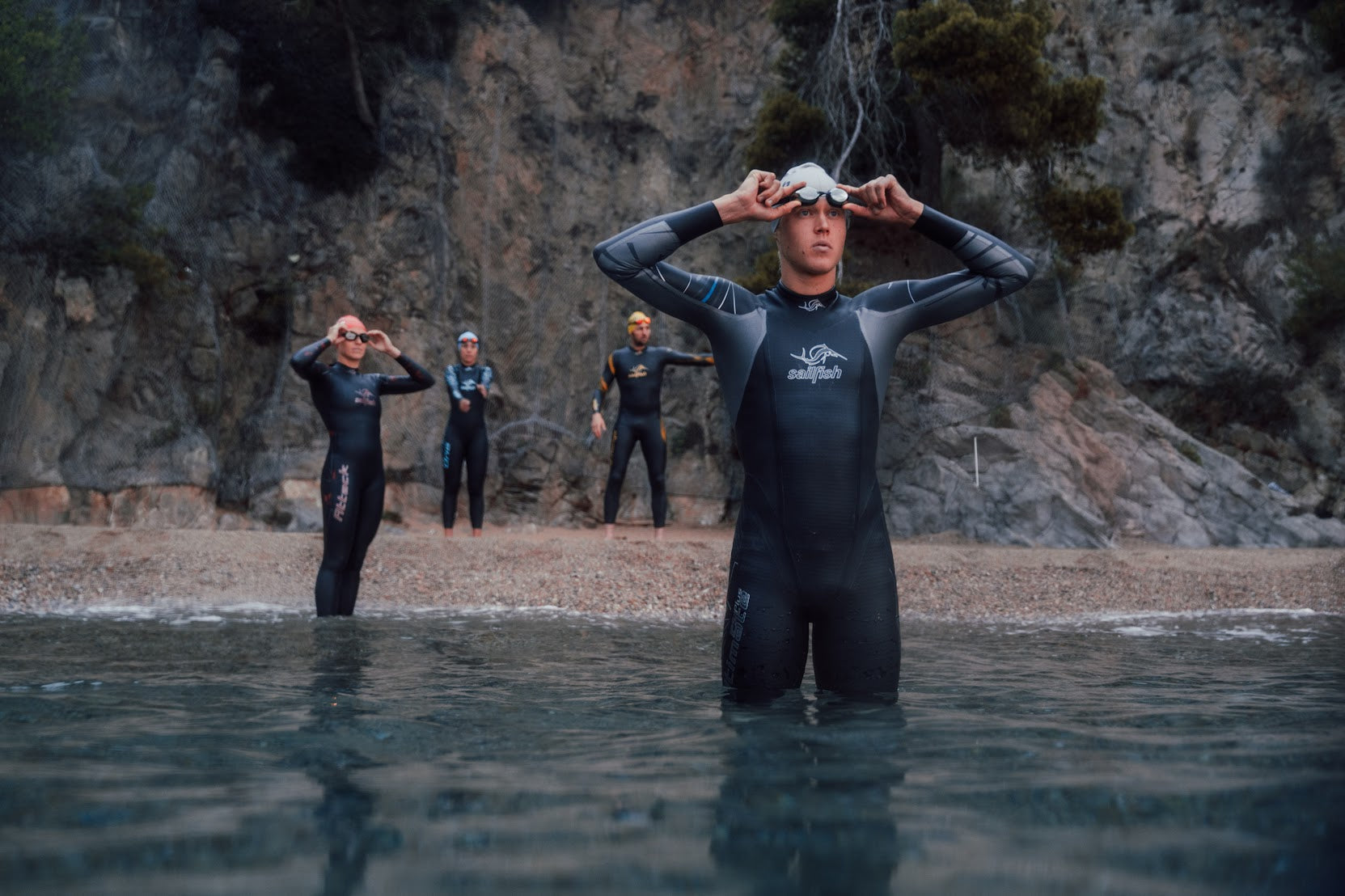
When you move from the pool into open water, the freedom of movement provided by your equipment becomes another important factor.
A well-fitting wetsuit should support your body without unnecessarily restricting your swimming movements. Flexibility around the shoulders is particularly important so that your freestyle stroke can feel as natural as possible.
Even a highly flexible wetsuit cannot compensate for limitations in your own mobility.
On the other hand, excellent shoulder mobility is of little use if your wetsuit fits too tightly or noticeably restricts every arm movement.
That is why it is worth considering both your physical mobility and the fit of your wetsuit.
If you are preparing for the upcoming open-water season, explore the sailfish wetsuit collection to find models designed for different swimming needs.
Why the Off-Season Is a Great Time for Mobility Training
During race season, training volume, demanding sessions and preparation for upcoming events often take priority.
That does not always leave much room for additional work on the fundamentals.
The winter months can be different. Many triathletes reduce their training volume after the season or shift their focus toward other areas. This creates an opportunity to work on technical and physical foundations.
Mobility training fits well alongside easier swim sessions, strength training and core stability exercises.
A practical approach is to choose one specific area to focus on over the coming weeks. Perhaps you want to improve your shoulder mobility, develop better control of your freestyle rotation or work on ankle flexibility.
Choose your priority, add suitable exercises to your weekly routine and pay attention to how your movements develop.
That way, the off-season becomes more than just a period of maintaining fitness. It is an opportunity to build a stronger foundation for your next swimming season.
Frequently Asked Questions About Swimming Mobility
Why Is Mobility Important for Swimming?
Adequate mobility allows you to perform the movements required for your swimming technique with control. Your shoulders, thoracic spine, hips and ankles all play important roles. How much additional mobility affects your performance depends on your individual limitations and technique.
What Are the Best Mobility Exercises for Swimmers?
Useful exercises include arm circles, wall slides, thoracic rotations, ankle mobility drills and controlled hip flexor stretches. The best exercises for you depend on which areas need more mobility or better movement control.
How Often Should Swimmers Do Mobility Training?
Several short sessions per week are a good starting point. For example, you could plan ten to fifteen minutes on three to five days each week. Consistency, appropriate intensity and good technique matter more than the length of a single session.
Can Better Mobility Make You a Faster Swimmer?
If limited mobility is restricting your technique, targeted mobility training may help you perform certain movements more effectively. However, greater flexibility alone does not automatically increase swimming speed. Technique, strength, coordination and endurance remain essential.
Should I Stretch Before or After Swimming?
Dynamic mobility exercises are generally a good choice before swimming because they help prepare your body for the movements ahead. Slower static stretches can be performed after training or during a separate mobility session.
Now It Is Your Turn: How Mobile Are You in the Water?
Every swimmer has different strengths and limitations. Some have naturally good shoulder mobility, while others struggle with upper-body rotation or restricted ankle movement.
So, we would like to hear about your experience.
Do you already include mobility exercises in your training routine, or do you mainly focus on your sessions in the water?
Maybe there is an exercise that has made a noticeable difference for you, or a particular area you have been meaning to work on.
Share your experience in the comments below. Which mobility exercises have helped you most? And what has become a regular part of your swimming routine?
Your experience might give another swimmer exactly the idea they need for their next training session.
enjoy your swim.


Leave a comment