


On July 5, 2026, the DATEV Challenge Roth gets underway – the world's largest long-distance triathlon by participant numbers. And as every year during race week, one of the most asked questions has nothing to do with the bike or running shoes – it's about the swim: wetsuit or swimskin?
Water temperatures in the Main-Danube Canal have climbed into the critical range early this season – and the situation is tight. In this article you'll find everything you need to know: the current temperature status, DTU regulations for pros and age groupers, why the canal is so warm – and what you should concretely do right now.
Current water temperature in the Main-Danube Canal
In a normal year, the Main-Danube Canal at Roth sees water temperatures of typically 20 to 23 °C in early July – a range in which the wetsuit is permitted for age group athletes in the vast majority of years.
2026 is different. Temperatures climbed significantly early in the season and are currently sitting in a zone that is unfamiliar territory for many athletes. A wetsuit ban for age groupers is a realistic scenario this year – something that has been the rare exception at Challenge Roth until now. That makes it all the more important to be prepared.
Note: the temperatures referenced here are based on available measurement data and reports at the time of publication. The official measurement that determines the race decision takes place on race day itself.
Why is the canal so warm?
Water temperature in a canal depends on several factors – and in 2026, multiple factors are working against the athletes simultaneously:
- Air temperature and sunlight: In the Roth/Hilpoltstein area, daytime highs of up to 37 °C are expected during race week – with feels-like temperatures exceeding 40 °C. Sustained heat over several days transfers directly into water temperature, especially in a relatively shallow canal.
- No lock operations: Normally, regular locking operations in the Main-Danube Canal cause a water exchange that cools the canal by up to 0.5 °C per lock cycle. Due to low water levels on the Danube, shipping traffic is currently suspended – this cooling effect is completely absent.
- No significant rainfall: Rain cools bodies of water in the short term. Current weather forecasts for race week show no precipitation – temperatures remain stably high.
- Time of measurement: Water temperature fluctuates throughout the day. Early in the morning – at race start time – it is typically slightly lower than in the afternoon. In borderline cases, this can be decisive.
The combination of these factors makes 2026 an exceptional year. Anyone who planned on a cool canal needs to rethink their approach.
The rules: pros vs. age groupers
Challenge Roth is governed by the regulations of the Deutsche Triathlon Union (DTU) – and the DTU rulebook draws a clear distinction between professional athletes and age group athletes. This is the decisive difference many people don't know about.
Professional athletes (elite)
For pros, a significantly stricter temperature threshold applies:
- Up to 21.9 °C: Wetsuit permitted
- From 22.0 °C: Wetsuit banned
With current canal temperatures, a wetsuit ban for the pros is virtually certain. Kristian Blummenfelt, Sam Laidlow, Patrick Lange and co. will in all likelihood be swimming without a wetsuit in Roth.
Age group athletes
For age group athletes on the long distance (swim over 1,500 m), the following thresholds apply:
- Up to 15.9 °C: Wetsuit mandatory
- 16.0 °C to 24.5 °C: Wetsuit permitted
- From 24.6 °C: Wetsuit banned – swimskin or trisuit
For age groups 60–64 and older, the same 24.5 °C threshold applies regardless of distance.
Important: when a wetsuit is banned, swim clothing must not cover areas below the elbows and below the knees, and must not generate buoyancy. Swimskins must be made of 100% textile material (nylon or lycra) – neoprene coatings are not permitted. Swimskins must be completely removed in T1 after the swim.
How is the temperature measured?
According to the DTU competition rules, the race jury measures water temperature one hour before the competition at several points along the course at a depth of 60 cm. The lowest temperature measured is the official race temperature. This rule protects athletes – it prevents isolated warmer spots from tipping the result towards a ban.
When is the final decision made?
The official decision on wetsuit permitted or banned is made on race morning, July 5, 2026, at 5:30 a.m. – one hour before the first start at 6:30 a.m. The decision is communicated via the official Challenge Roth app and via the event's social media channels.
There is therefore no advance guarantee. What you can do: in the days before the race, the race management will share tendencies on their channels. Keep an eye on those channels.
And sailfish will keep you updated too – follow us on Instagram for the most current updates directly from Roth.
The two scenarios: what does this mean for you?
Scenario 1: water temperature below 24.5 °C → wetsuit permitted
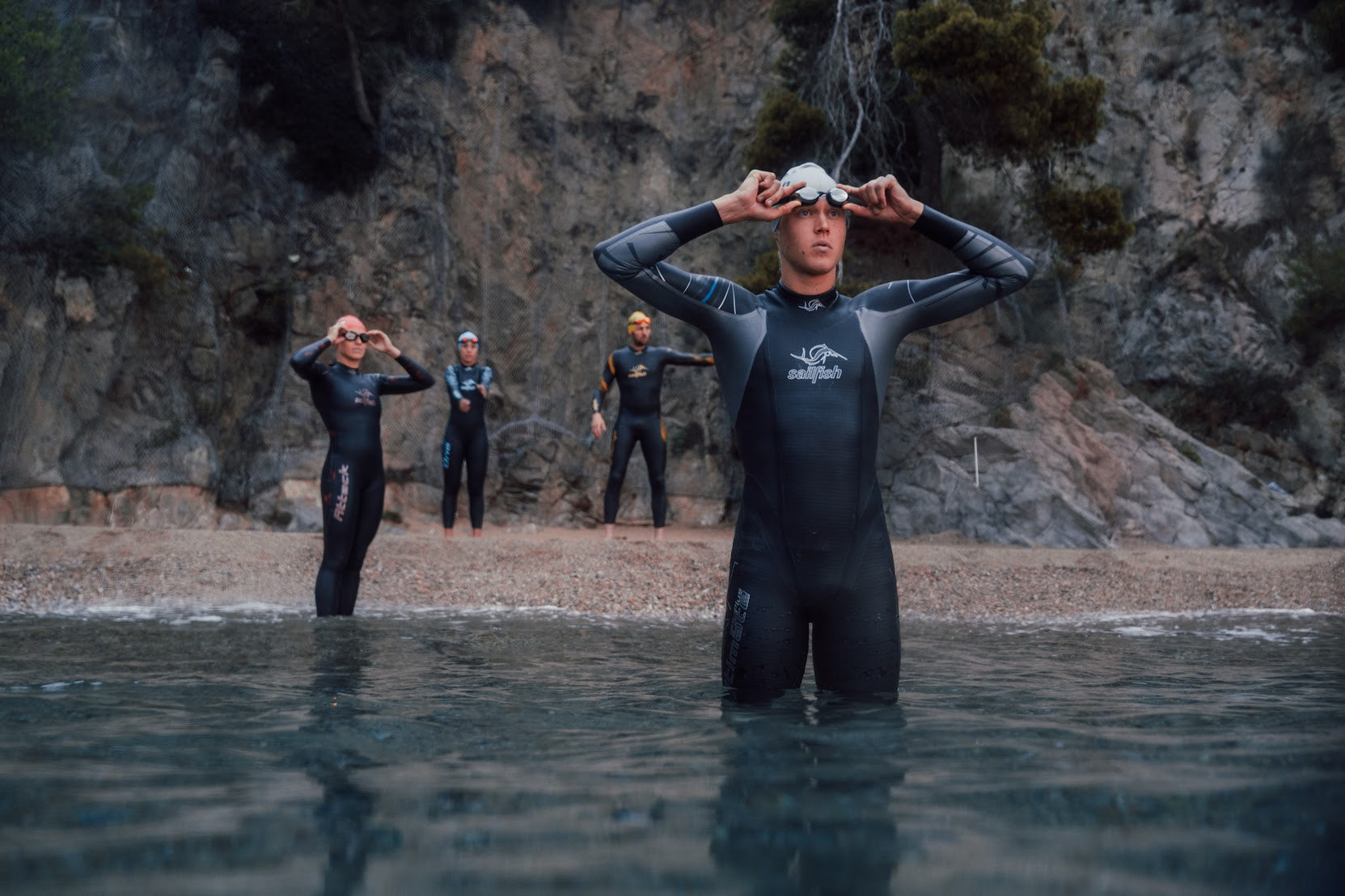
For age group athletes, the wetsuit is then permitted – and in most cases clearly the faster choice. Buoyancy, better body position in the water, more energy saved for the bike and run. Use that advantage.
Scenario 2: water temperature from 24.6 °C → wetsuit banned, swimskin permitted
For age group athletes this means: no wetsuit, but a regulation-compliant swimskin (100% textile, no buoyancy, no neoprene coating) is permitted. For the pros, the wetsuit ban at these temperatures has been clear for some time. Now age groupers are affected too.
Our recommendation: pack both options – wetsuit and swimskin. The decision doesn't come until 5:30 a.m. Anyone arriving with only one option is rolling the dice.
So, wetsuit or swimskin – our take
Good question. And the honest answer is: it's completely open right now – and the weather forecast for the coming days actually points towards the wetsuit.
Yes, the water temperature in the Main-Danube Canal is currently in the critical range. But canal water responds to weather changes – and the forecast for race week has shifted significantly. After the heatwave of recent days (up to 37 °C in the region), thunderstorms and a noticeable cool-down are arriving from the weekend:
- Sun/Mon, June 28/29: Thunderstorms and temperature drop, highs around 21–28 °C
- Tue–Thu, June 30 to July 2: Unsettled, rain at times, temperatures between 23 and 26 °C
- Fri/Sat, July 3/4 (race week): Cloudy with scattered showers, max. 24–25 °C
- Sun, July 5 (race day): Around 26 °C air temperature currently forecast – significantly more moderate than the preceding heat week
Rain and cooler air over several days can measurably lower the water temperature in the canal. Every rainy day, every cool night, every thunderstorm during race week works in the direction of wetsuit permitted. How significant the effect will be depends on the intensity and duration of precipitation – something that can't be predicted with certainty at this point.
Our take: the chances of a wetsuit being permitted for age groupers are real – and higher than the current canal temperature might suggest. Anyone who has already written off their wetsuit should dig it back out. Anyone betting exclusively on a swimskin is taking a risk.
The safest strategy remains: pack both suits, wait until 5:30 a.m. on race day – and then make the right call.

Without a wetsuit: what matters for the swimskin
A swimskin is not a wetsuit substitute – but in the event of a ban, it's the best equipment you can legally use. What matters?
- Regulatory compliance: Exclusively textile material (nylon, lycra). No neoprene, no neoprene coating, no material that generates buoyancy. Check this before the race.
- Fit: A swimskin must fit like a second skin. Too loose = water resistance, too tight = restricted shoulder rotation. Test it beforehand – not for the first time on race day.
- Water repellency: High-quality swimskins absorb very little water – reducing weight and drag over all 3.8 km.
- Transition: The big advantage of the swimskin: it comes off in seconds. T1 can be significantly faster without a wetsuit.
- Not for the first time on race day: Anyone who has never worn their swimskin in water should absolutely do so before the race – at the official test swims on Friday or Saturday.
Stay updated – don't miss a thing
The situation is changing daily. Here are the most important sources to monitor over the coming days:
- Challenge Roth app: This is where the final decision will be announced on race morning at 5:30 a.m.
- @challengeroth on Instagram: Tendencies and temperature updates will be published in the days before the race.
- @sailfish_triathlon on Instagram: We'll keep you up to date with the latest info and equipment recommendations – directly from the community.
And most importantly: be prepared for both scenarios. Anyone planning on a wetsuit who doesn't have a swimskin will lose valuable time and energy in the event of a ban – not because of poor form, but because of poor preparation.
Whatever comes: the Main-Danube Canal, 3.8 km, thousands of fans lining the course – that's Challenge Roth. With or without a wetsuit.
Enjoy your swim.


Leave a comment