


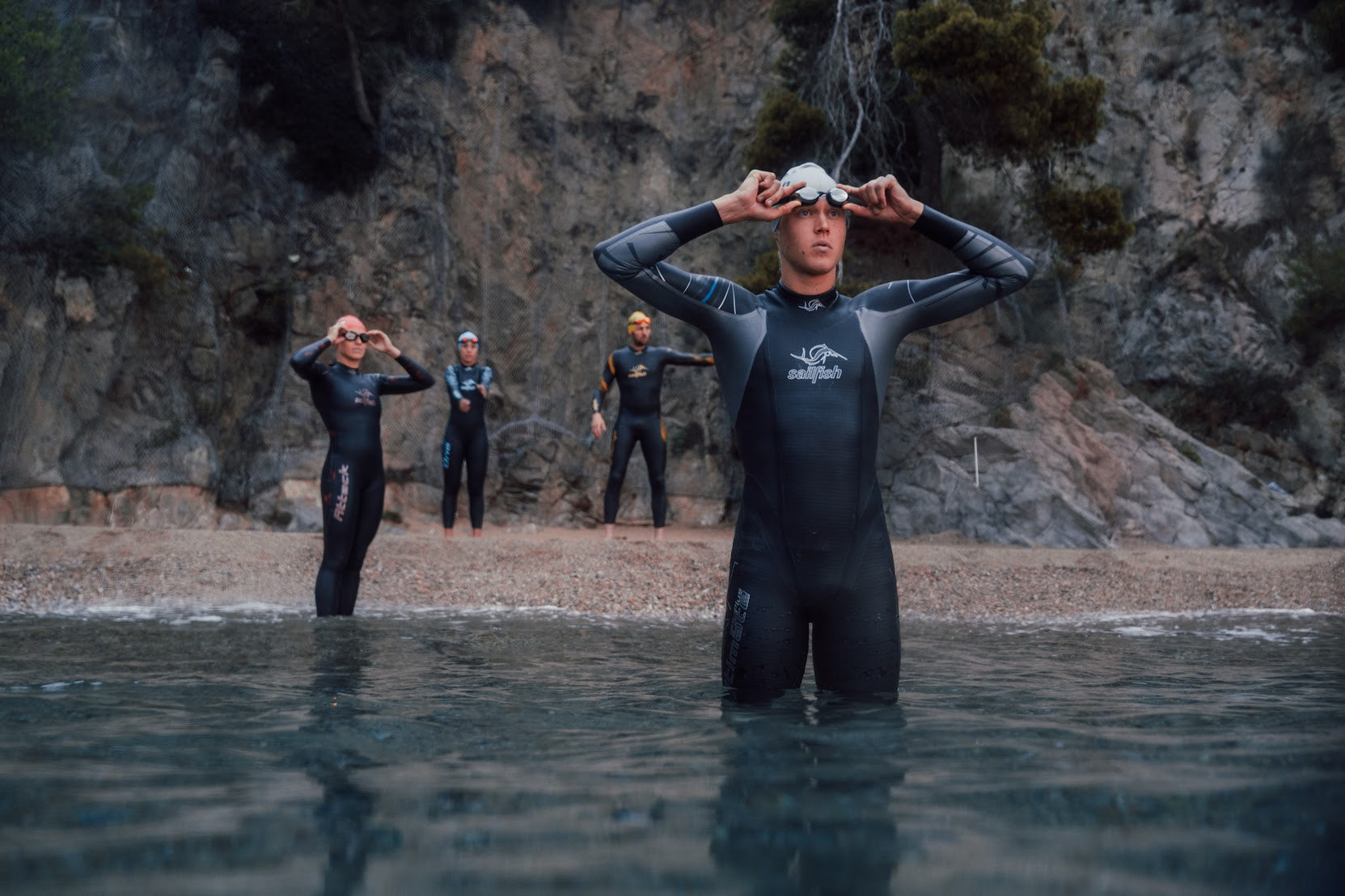
In the pool, there's a black line on the bottom. In open water, there isn't. Instead, you have to stay on course yourself – toward a buoy, a landmark, or the shore ahead. That's what sighting means: briefly lifting your eyes during the freestyle stroke to check your direction. Without it, you swim in curves, waste energy and time, and in a race you can easily cover several hundred extra meters without even noticing.
What is sighting, and why does it matter in open water?
Sighting means briefly lifting your head during the stroke to look ahead and check your position relative to the course. In the pool, you orient yourself automatically using the black line, the wall, and the lane markers. In a lake or the sea, none of that exists. Without regular sighting, you'll drift – usually toward your dominant breathing side – and end up swimming a curve instead of a straight line. Over a 1500-meter swim, that can easily add 100 to 200 meters of extra distance: time you don't get back.
The right technique: sighting without losing your rhythm
Head position and timing
The trick to sighting is to disrupt your stroke rhythm as little as possible. Lift your head briefly, right before you turn to breathe, glance forward, and lower your head again immediately before taking that breath to the side. The forward glance should last only a split second – just long enough to spot the buoy or landmark. If you hold your head up too long, your hips drop and you slow yourself down. The movement should feel like a quick flash, not a pause.
How often should you sight?
There's no fixed rule, but a good starting point is: sight roughly every 6 to 10 strokes, depending on visibility and conditions. In calm water with good visibility, you can sight less often. In waves, murky water, or glare, sight more frequently, since you drift off course faster and landmarks are harder to spot. In the end, the exact count matters less than the instinct: better to check slightly too often than to realize too late that you're 30 meters off your ideal line.

Common sighting mistakes
The most common mistake is lifting the head too high and holding it up too long. That costs energy and throws off your body position. The second common mistake: sighting only at the start of a race, when the field is still together, and then stopping once swimmers spread out. If you're swimming alone, regular sighting matters even more. A third, often underestimated factor: poorly fitting or fogged-up swim goggles. If you can't see clearly in that split second, even perfect technique won't help much.
How to train sighting
Sighting can be trained deliberately, even in the pool. Build sighting into your technique sets – for example, every fourth or fifth length, glance forward regularly toward the wall ahead. That way, the movement becomes automatic before you need it under pressure in open water. In a lake or the sea, it helps to memorize two or three landmarks before the start, like a tree on the shore or a distinctive building, in case the buoy itself is hard to spot. For extra visibility to others while you focus on your own orientation, many swimmers also use an open water swimming buoy – it won't help your sighting directly, but it makes you easier to spot for boats and other swimmers.
Frequently asked questions
How often should I sight while open water swimming?
A good guideline is every 6 to 10 strokes, more often in waves or poor visibility.
Why do I lose speed when I sight?
Usually because the head is lifted too high. A short, flat glance forward disrupts your body position far less than a long upward lift.
Do swim goggles matter for sighting?
Clear, well-fitting, fog-free goggles are the baseline requirement for actually seeing anything during that quick glance – especially in glare or waves.
Sighting isn't about talent, it's about repetition. Once the technique is built into your training, you'll swim straighter in competition – and calmer, because the uncertainty about your position disappears. Enjoy your swim.


Leave a comment